I should also address the technical aspects. What does repacking involve? It might include using software to re-encode the video, adjusting bitrates, or converting formats. These technical terms can be explained in layman's terms. Additionally, the community aspect—how repacks are shared through forums or torrent sites—plays a role in their distribution.
First, I should define what juiceanimehostelep03 repack is. Maybe it's a term used in the anime community for a specific repack of an anime, perhaps one that's been optimized for faster downloads or higher quality using different codecs. The "hostelep03" part might refer to a particular hoster or a specific episode format. I need to confirm this but for the essay, I can frame it as an example of such repacks.
In the vibrant world of anime fandom, terms like "JuiceAnimeHosTelep03 Repack" emerge as part of the subculture surrounding the distribution and consumption of anime content. While the phrase may seem cryptic, it encapsulates the broader practice of repackaging anime episodes for redistribution, a practice that sits at the crossroads of accessibility, legality, and ethics. This essay explores the nature of "JuiceAnimeHosTelep03 Repack," its motivations, technical intricacies, and the contentious legal and ethical debates it sparks. Repacks, such as the hypothetical JuiceAnimeHosTelep03 , typically involve re-compressing or re-encoding existing anime episodes to optimize file size, enhance video quality, or adapt formats for easier sharing. The term "repack" suggests a secondary or modified version of the original source material. While the JuiceAnimeHosTelep03 name might be a specific example used by a community or platform (possibly referencing a hoster like "hostelep03" or a reencoder), it reflects a common phenomenon in anime fandom: fans seeking to share or access content beyond official channels. juiceanimehostelep03 repack
Finally, the conclusion should summarize the key points, reiterating the necessity to balance fan demand with respect for intellectual property rights. Maybe suggest that supporting legal platforms encourages the growth of the anime industry and ensures that creators are fairly compensated.
Community-driven platforms often play a role in this ecosystem, with dedicated forums or torrent sites facilitating the sharing of repacks. These spaces foster a sense of camaraderie among fans but also centralize illegal distribution, complicating enforcement of copyright laws. At the heart of the debate lies the clash between fan demand and intellectual property rights. Repacking, repackaging, or redistributing copyrighted anime content without authorization is a copyright violation in most jurisdictions. Anime studios and distributors invest significantly in production and marketing; illegal distribution undermines their ability to monetize their work, potentially stifling future projects. Furthermore, the ethical responsibility of consumers is a key point—if fans do not pay for content, creators may struggle to sustain their craft. I should also address the technical aspects
Fans, too, must weigh their choices. Supporting legal platforms ensures that anime creators receive compensation, fostering a sustainable ecosystem where new and diverse stories can thrive. Ethical consumption does not demand perfection but awareness—recognizing that every repacked episode downloaded bypasses the financial lifeline of artists, animators, and writers. The term "JuiceAnimeHosTelep03 Repack" exemplifies the complex interplay between fan enthusiasm, technical ingenuity, and ethical responsibility. While repacks serve practical needs for some, they remain a legal gray zone with real consequences for the anime industry. The solution lies not in vilifying fans but in transforming the landscape of anime distribution, ensuring that legality does not come at the cost of access. By championing legal, accessible platforms and fostering a culture of respect for intellectual property, fans and creators can build a future where art thrives without compromise.
Then, there's the argument about why some people defend repacks. They might argue that it's a necessity for fans due to limited legal options. However, I need to counter this with the legal perspective, the impact on creators and the industry, and perhaps mention legal alternatives like streaming services. These technical terms can be explained in layman's terms
I should also mention legal consequences, though they vary by country. In some places, downloading pirated content can lead to fines or other penalties. It's important to highlight the ethical responsibility in consuming content legally.

The vision of Maps-For-Free is to offer free worldwide relief maps and other layers which can easily be integrated into existing map projects.
MFF-maps are released under Creative Commons CC0. You are free to adapt and use the relief maps and relief layer for commercial purposes without attributing the original author or source. Although not required, a link to maps-for-free.com is appreciated.
SRTM (Shuttle Radar Topography Mission) was developed to collect three-dimensional measurements of the Earth's surface to generate a near-global digital elevation model (DEM). The mission was a cooperative project between the National Aeronautics and Space Administration (NASA), the National Geospatial-Intelligence Agency (NGA) of the U.S. Department of Defense (DoD), and the German and Italian space agencies.
SRTM flew on board the Space Shuttle Endeavour in February 2000 and used an interferometric radar system to map the topography of Earth's surface. Endeavour was launched in an orbit with an inclination of 57 degrees which allowed to map all of the Earth's landmass that lies between 60 degrees North and 56 degrees South.
SRTM data was processed into geographic tiles, each of which represents one by one degree of latitude and longitude. A degree of latitude measures 111 kilometers North South, a degree of longitude measures 111 kilometers East West or less, decreasing away from the equator. Each tile of this dataset contains 1201x1201 samples which is equipollent to a 90 m grid resolution at equator. All tiles together represent an image sized 432000 x 139200 pixel.
For technical reasons data are available between 60 degrees North and 56 degrees South latitud only. The relative horizontal accuracy is about ± 15 m, the relative vertical accuracy about ± 6 m. The original data came with data voids indicating insufficient contrast in the radar data. These data voids tend to occur over water bodies (lakes, rivers, coasts, etc.), areas with snow cover and in mountainous regions.
The original SRTM data are available from USGS.
GTOPO30 is another free geographic dataset with a resolution of 43200 x 21600 pixel used to cover regions where SRTM data are not available. Streaky regions denote areas where data voids were extrapolated or where SRTM data were replaced by the lower resolution GTOPO30 data.
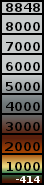
The relief maps are elevation maps, i.e. the coloring does not reflect the natural colors of scenic objects. Because one color is used for each ground level, some rivers and other objects may appear in unnatural colors. Lowland areas containing only few elevation information appear most likely single-colored.
In some cases the SRTM or GTOPO30 dataset failed to include small islands, and in other cases the islands are slightly mispositioned.
The GTOPO data are also available from USGS.
VMap0 provides worldwide coverage of geo-spatial data and is equivalent to a scale of 1:1000000. The data are structured following the Vector Product Format (VPF) and can be downloaded from GIS-Lab. Most of the MFF-layers are based on one of the thematic data vmap0 layer.
Hans Braxmeier, hans.braxmeier@outlook.com