|
|
|
|
|
|
|
|
|
|
|
|
|
|
 |
|
||||||||||||
|
|
|
|
|
|
|
|
|
|
|
|
|
|
|
|
|
||||||||||||
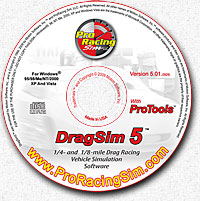
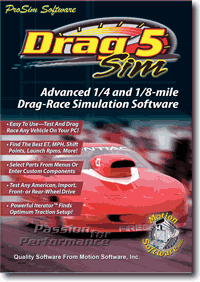
| DragSim5 Vehicle-Dynamics 1/4- or 1/8-Mile Drag-Strip Simulation Includes ProTools™ Enhancements | ||||
|
DragSim5™
with ProTools™ is an
amazingly accurate 1/4- and 1/8-mile vehicle-dynamics
simulation for
Windows Vista, 7, 8, and 10 (32- and 64-bit) from the
experts at Motion Software, Inc. The simulation lets you to design and build any car, motorcycle or dragster
and accurately evaluate its performance at simulated dragstrip! Enter
any engine power curve, or test engines you've designed in DynoSim or Dynomation (you
can even test a variety of jet and rocket power plants!).
Test any manual or automatic transmissions, any gear ratios, any vehicle
weight, wheelbase, driving style, weather and traction conditions and more! Change
components with just a mouse click—drag-race times are instantly
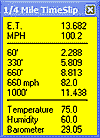
updated. A PopUp TimeSlip™ provides an easy-to-read visual summary of
overall vehicle performance. Even
test and compare multiple vehicles at once! Software Overview: DragSim5 simulates virtually any Automobile, Dragster, or Motorcycle using front- or rear-wheel drive! The simulation performs a comprehensive analysis of the physics that act on the vehicle as it accelerates from a standing start to terminal velocity over the 1/8- or 1/4-mile. This iterative (repeating, step-by-step) analysis determines vehicle performance for each fraction of an inch throughout the entire race. The results display looks similar to a professional data-acquisition system! You'll clearly see exact elapsed times, speeds, rpms, beginning at rollout to 60 feet, 330 feet, 660 feet (1/8-mile), 1000 feet, and 1320 feet (1/4-mile). ETs and speeds can be compared with up to four other vehicles to help locate the best component combinations. User Interface And
Features: DragSim5 has a completely
unique user interface built from the
ground-up to be clear and easy use. You'll find vehicle component parts and
specifications on the left side of the screen, and simulation results on the
right! Eye-popping graphics are Even though this program is sophisticated, DragSim5 was carefully designed to be easy to use. For example, a Pop-Up TimeSlip™ provides an instant summary of the performance potential of any vehicle. A quick glance will help you make judgments about gear ratios, shift points, vehicle weight, and it can even help you evaluate traction and wheelspin!. Similar to the paper time slip delivered to racers at the end of a run, the DragSim5 Pop-Up TimeSlip™ is a helpful, at-a-glance analysis of track results.
ProTools™: Professionals need all the modeling power they can get. The ProTools™ included in DragSim5 extend the functionality of many program features. For example, the ProIterator™ lets you perform fully custom testing, DataZones™ give you the most graphing and data analysis power possible, ProData™ includes a new table of extended vehicle performance data, and ProPrinting™ prints out a comprehensive test report that can include your name, address, custom logo, glossaries, and all ProData™ values. If you're serious about drag racing, the DynoSim5 with ProTools™ was made for you! Technical (under the
hood):
DragSim5 simulates the complex physics involved in 1/8- and
1/4-mile drag racing, including the incredible range of forces that act on
automobiles, dragsters, or motorcycles at the starting Users Manual: The DragSim5 is supplied with a full-color on-disk Users Manual (directly accessible from within the program) that details the features of this comprehensive simulation. If you wish, you can download a copy of this manual to preview the capabilities of this software before you buy (link provided at top of this page). Requirements: DragSim5 runs on any Windows 7, 8 10 or 11 equipped PC. A video display of 1024 x 768 resolution or greater is recommended. A Windows-compatible printer is required for test reports. Availability: The DragSim5 is available NOW!. See our Order Page for purchase information and Discount pricing. What You Can Do With The DragSim:
Tune These Key Vehicle Components:
What The Pros Say About The DragSim:
|
Compare Our Drag
Simulation
FREE—Download
Special Web Pricing What's New This Version:
Features:
Requirements:
|
|||
|
|
|
|
|
|
|
|
|
|
|
|
|
|
Structuring Social and Political Life Old books contribute concrete structures—laws, rituals, hierarchies—that shape institutions. Religious scriptures prescribe liturgy and moral law, which become the basis for religious authority and social cohesion. Philosophical works (e.g., Plato’s Republic, Confucian Analects) offer blueprints for governance, education, and ethical behavior. These writings inform legal systems, educational curricula, and political philosophy, embedding a "Genesis order" into the mechanisms of daily life. The authority of such texts often legitimizes social stratification and gender roles and informs economic practices, thereby stabilizing a society’s foundational arrangements.
The phrase "the Genesis order" suggests a foundational sequence or origin—an organizing principle that shapes subsequent development. When paired with "old books," it evokes the influence of ancient texts—scriptures, early legal codes, classical works, and mythic narratives—that established the conceptual frameworks for societies, knowledge systems, and moral orders. This essay examines how those "old books" produced a Genesis order: how they originated ideas, structured institutions, and perpetuated cultural continuity and change. the genesis order old books work
Origins and Authority Old books often claim authority by positioning themselves as origins—creation stories, founding charters, or revealed texts that explain why the world is as it is and how people should live. Genesis in the Judeo-Christian tradition, for example, functions as a cosmology and moral primer: it narrates creation, the nature of humanity, and the roots of disorder. Similarly, ancient legal codes like Hammurabi’s Code present an early social contract, setting the boundaries of justice and governance. By offering accounts that answer "where we come from" and "what we must do," these texts generate an initial order that societies accept, contest, and adapt. Structuring Social and Political Life Old books contribute
Conclusion The "Genesis order" supplied by old books is both practical and symbolic: it provides legal codes, social rituals, and institutional frameworks while offering narratives that anchor identity and meaning. Through authority, transmission, interpretation, and contestation, these texts shape the contours of societies over centuries. Understanding their role requires attention to how they were read, who controlled them, and how communities reworked them. The legacy of the old books is thus neither wholly preservative nor wholly progressive—it is an enduring dialogue between origins and the ongoing task of making order meaningful in changing times. When paired with "old books," it evokes the
Cultural Memory and Identity Books from antiquity crystallize collective memory and identity. Myths, genealogies, and foundational narratives create shared origins that bind communities across generations. For instance, epic poems like the Iliad and the Mahabharata do more than entertain; they encode ideals of heroism, duty, and the social order. Scriptural genealogies and origin stories provide a sense of peoplehood and continuity, enabling groups to maintain identity through turbulence and change. The "Genesis order" is thus cultural as well as institutional: a narrative scaffold that supports communal self-understanding.

 performance or
racing application, automatically! DragSim5 is the most powerful and
easy-to-use straight-line vehicle-dynamics simulation available! And it’s
fun to use, too!
performance or
racing application, automatically! DragSim5 is the most powerful and
easy-to-use straight-line vehicle-dynamics simulation available! And it’s
fun to use, too!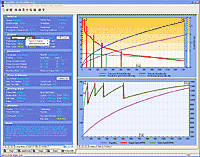 enhanced with
QuickAccess™ buttons and
DirectClick™
menus that let you change parts simply by clicking on any component. Analyze engine
RPM, Clutch RPM, Torque Converter Stall Speed, Acceleration, Tire Slip, Distance, ET, Aero Drag, and much more
(detailed below). All data and graphs can be
printed (and previewed) in color.
enhanced with
QuickAccess™ buttons and
DirectClick™
menus that let you change parts simply by clicking on any component. Analyze engine
RPM, Clutch RPM, Torque Converter Stall Speed, Acceleration, Tire Slip, Distance, ET, Aero Drag, and much more
(detailed below). All data and graphs can be
printed (and previewed) in color.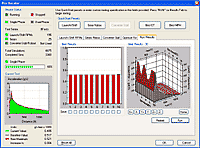 DragSim5 also incorporates
(Motion-exclusive) technology that helps you find
optimum combinations for any vehicle. To
start off,
the simulation includes a
Traction Calculator™ that optimizes tire/track modeling and
improves accuracy. A simple button click begins a comprehensive series of
hundreds of thousands of calculations to determine the tire/track adhesion
model that best simulates read-world conditions. You'll also be amazed by
Iterator™ testing built into DragSim5 that lets you "home in" on the best parts combinations, automatically!
Click one button and DragSim will perform hundreds,
or thousands of
drag tests! The Iterator™ keeps
track of all the results, and displays the best gear ratios and other parts combinations for you to review.
You'll locate the setup that delivers the quickest ET or the fastest MPH for any
street or racing application!
DragSim5 also incorporates
(Motion-exclusive) technology that helps you find
optimum combinations for any vehicle. To
start off,
the simulation includes a
Traction Calculator™ that optimizes tire/track modeling and
improves accuracy. A simple button click begins a comprehensive series of
hundreds of thousands of calculations to determine the tire/track adhesion
model that best simulates read-world conditions. You'll also be amazed by
Iterator™ testing built into DragSim5 that lets you "home in" on the best parts combinations, automatically!
Click one button and DragSim will perform hundreds,
or thousands of
drag tests! The Iterator™ keeps
track of all the results, and displays the best gear ratios and other parts combinations for you to review.
You'll locate the setup that delivers the quickest ET or the fastest MPH for any
street or racing application!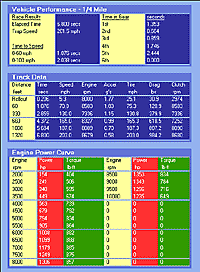 line. But you can leave your physics books on the shelf, because the
DragSim5 makes complex vehicle analysis as easy as 1, 2, 3. Pop-up menus allow you to enter any
engine power curve (also import DynoSim6 and Dynomation6 and other engine files). You can even test jet
or rocket power plants! Then choose vehicle components from simple drop-down
menus or enter custom specs for automatic or manual transmissions, torque
converter stall-speed, launch rpm, shift rpms, up to six transmission gears
with virtually any gear ratios, rear-axle ratios, vehicle weight, wheelbase,
front- or rear-wheel drive, frontal area, aero drag, tire width, rollout
distance, ambient temperature, humidity, wind speed, and more! Internal
"watchdogs" eliminate conflicting choices (like an rpm redline rpm set lower
than a shift rpm, etc.), ensuring accurate performance predictions.
line. But you can leave your physics books on the shelf, because the
DragSim5 makes complex vehicle analysis as easy as 1, 2, 3. Pop-up menus allow you to enter any
engine power curve (also import DynoSim6 and Dynomation6 and other engine files). You can even test jet
or rocket power plants! Then choose vehicle components from simple drop-down
menus or enter custom specs for automatic or manual transmissions, torque
converter stall-speed, launch rpm, shift rpms, up to six transmission gears
with virtually any gear ratios, rear-axle ratios, vehicle weight, wheelbase,
front- or rear-wheel drive, frontal area, aero drag, tire width, rollout
distance, ambient temperature, humidity, wind speed, and more! Internal
"watchdogs" eliminate conflicting choices (like an rpm redline rpm set lower
than a shift rpm, etc.), ensuring accurate performance predictions.